Java Basics
Features of Java
Java became one of the most widely used programming languages because it was designed with key characteristics that developers love. These features of Java programming language—often called Java buzzwords—include simplicity, object-orientation, security, robustness, and platform independence. This lesson explores why Java is popular and what makes it a powerful choice for modern software development.
Quick answer
What are the main features of Java?
Java is class-based, strongly typed, portable through bytecode and the JVM, and supports managed memory, exceptions, multithreading and object-oriented design.
What you will learn
- The key features that distinguish Java from other programming languages.
- Why Java is highly favored for enterprise and Android development.
- How Java achieves platform independence and security.
1. Java is Simple
Java was designed to be easy to learn, write, and maintain. Its syntax is largely based on C++, making it familiar to many programmers, but it deliberately removes the most complex and error-prone features of its predecessors.
- No explicit pointers: Unlike C/C++, Java does not allow direct memory manipulation through pointers, significantly reducing memory access errors.
- Automatic memory management: Java includes a Garbage Collector that automatically frees memory occupied by unused objects, freeing developers from manual memory deallocation.
2. Java is Object-Oriented
In Java, almost everything is an object. This Object-Oriented Programming (OOP) methodology allows developers to model real-world entities efficiently, making large software architectures highly modular and maintainable.
// Real-world modeling with classes
public class Car {
    private String brand;
    private int speed;

    public Car(String brand) {
        this.brand = brand;
        this.speed = 0;
    }

    public void accelerate() {
        speed += 10;
        System.out.println(brand + " is now going " + speed + " km/h");
    }
}

// Creating and using objects
Car myCar = new Car("Toyota");
myCar.accelerate();  // Output: Toyota is now going 10 km/h
Why it matters
OOP concepts like Encapsulation, Inheritance, Polymorphism, and Abstraction allow teams to write reusable code, drastically reducing development time and bugs in enterprise-level applications.
3. Java is Platform Independent
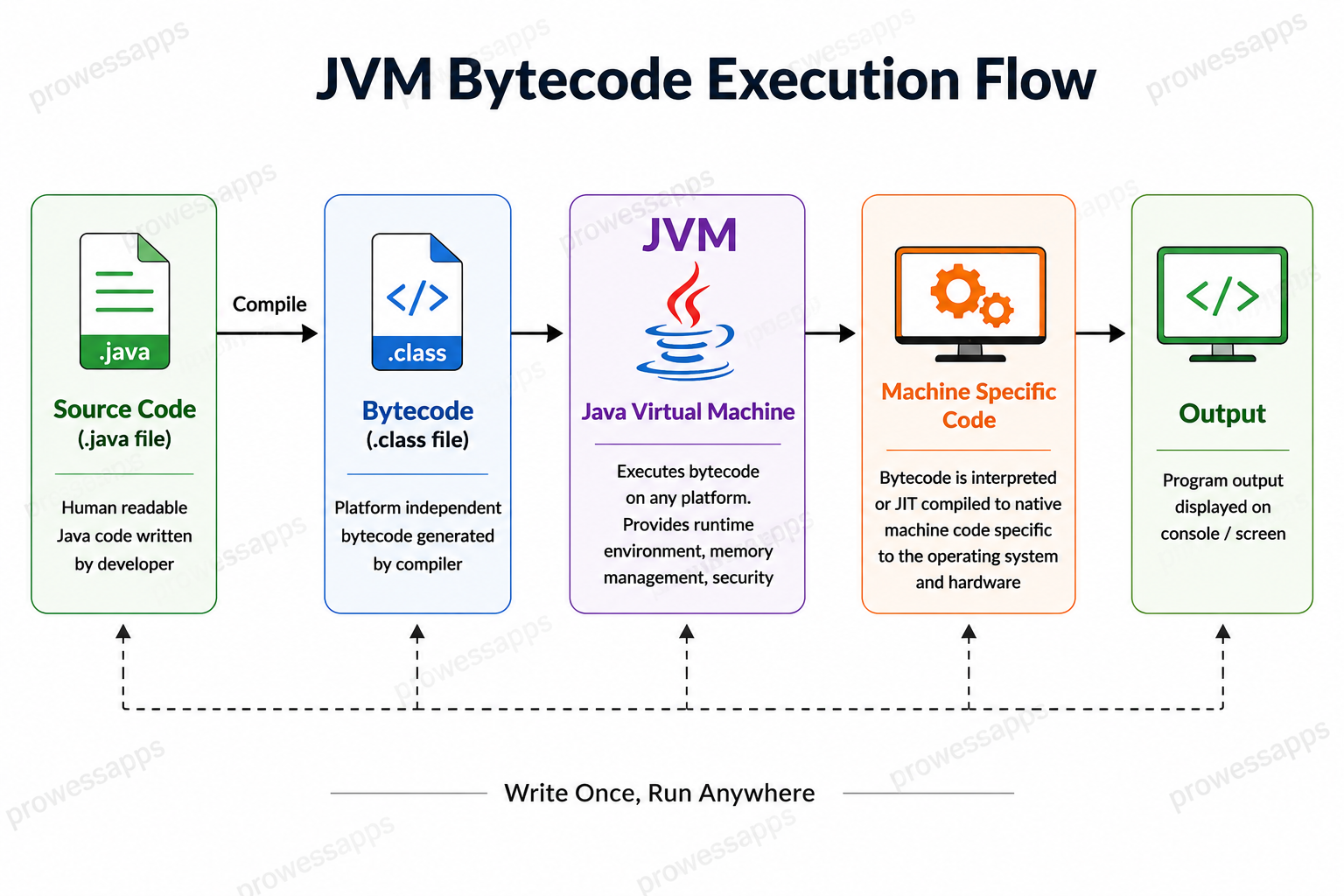
Unlike C or C++, which are compiled into machine-specific binaries, Java source code is compiled into an intermediate format called bytecode.
This bytecode can run on any operating system (Windows, Linux, macOS) that has a Java Virtual Machine (JVM) installed, perfectly embodying the famous Java principle: Write Once, Run Anywhere (WORA).
Source Code (.c)
    ↓ Compile for Windows
Windows Executable (.exe)
    ↓ Compile for Linux
Linux Binary (different file)
    ↓ Compile for Mac
Mac Binary (different file)
Source Code (.java)
    ↓ Compile ONCE
Bytecode (.class)
    ↓ Run on ANY JVM
✓ Windows JVM
✓ Linux JVM
✓ Mac JVM
4. Java is Secure
Security was a primary design goal for Java, especially for applications running over networks. Java is widely recognized for its robust security features:
- No explicit pointers: This prevents unauthorized access to protected memory areas.
- Bytecode Verifier: Before execution, the JVM verifies that the bytecode doesn't violate access rights or contain illegal code.
- Sandboxed Execution: Java applications run inside a virtual machine sandbox, isolating them from the host operating system.
5. Java is Robust
The term "robust" simply means strong and reliable. Java uses strict compile-time checking and runtime checking to eliminate error-prone situations early.
Furthermore, Java's robust Exception Handling allows programs to gracefully catch and handle runtime errors (like network failures or file missing errors) without crashing the entire application. Combined with Automatic Garbage Collection, Java applications are highly resistant to memory leaks and crashes.
6. Java is Portable
Because Java bytecode is independent of any specific hardware architecture, Java is highly portable. You can compile a Java program on a Windows desktop and run the exact same compiled file on a Linux cloud server.
Additionally, Java strictly defines the sizes of primitive data types. For example, an int in Java is always 32 bits, regardless of whether you run it on a 32-bit or 64-bit operating system, ensuring consistent behavior across all platforms.
7. Java is Multithreaded
Java has built-in support for multithreading, which means a single Java program can perform many tasks concurrently.
Instead of executing tasks one by one, a multithreaded application can process background operations (like fetching data from a database) while still keeping the user interface responsive. This is vital for high-performance servers, games, and modern mobile apps.
8. Java Supports Distributed Applications
Java was built with the Internet in mind. It includes a vast standard library for networking, allowing developers to easily create distributed applications that communicate with each other over networks and APIs (using technologies like RMI, Sockets, and modern REST frameworks like Spring Boot).
9. Java is High Performance
Historically, interpreted languages were slower than compiled languages. However, Java bridges this gap using Just-In-Time (JIT) compilers inside the JVM.
The JIT compiler analyzes the bytecode as it runs and translates frequently executed parts directly into native machine code. This allows modern Java applications to achieve performance levels remarkably close to fully compiled languages like C++.
10. Java is Architecture Neutral
Java is architecture neutral because its compiler generates bytecode that has no dependencies on a specific computer architecture. The Java specification doesn't have implementation-dependent aspects—for example, the size of primitive types is fixed regardless of the underlying hardware.
intis always 32 bitslongis always 64 bitsfloatis always 32-bit IEEE 754
11. Java is Dynamic
Java is considered dynamic because it can adapt to an evolving environment. Java programs carry extensive runtime information that can be used to verify and resolve access to objects at runtime.
- Dynamic class loading: Classes are loaded on-demand at runtime, not all at once at startup.
- Reflection API: Programs can inspect and modify their own structure at runtime.
- Dynamic linking: New classes can be linked in while the program is running.
How Java Compares to Other Languages
| Feature | Java | C++ | Python |
|---|---|---|---|
| Platform Independence | ✅ Yes (JVM) | ❌ No | ✅ Yes (Interpreter) |
| Memory Management | ✅ Automatic (GC) | ❌ Manual | ✅ Automatic (GC) |
| Pointers | ❌ No | ✅ Yes | ❌ No |
| Compilation | Compiled + JIT | Compiled | Interpreted |
| Speed | Fast | Fastest | Slower |
What’s next?
Now that you understand what makes Java so powerful, continue with History of Java to discover how this language evolved over the decades.
Lesson summary
- Java's simplicity comes from removing complex features like manual memory management and explicit pointers.
- Platform independence is achieved through bytecode and the JVM (Write Once, Run Anywhere).
- Security and robustness are enforced through bytecode verification, exception handling, and automatic garbage collection.
- Multithreading allows Java applications to perform multiple operations concurrently.
Further reading
If you want to dive deeper into the concepts mentioned in this lesson, check out these related topics:
Frequently asked questions
Why is Java considered platform independent?
Java source code is compiled into bytecode, which can run on any system that has a compatible Java Virtual Machine (JVM) installed, enforcing the 'Write Once, Run Anywhere' principle.
What makes Java a secure programming language?
Java restricts direct pointer access to memory, uses a bytecode verifier to ensure code integrity before execution, and runs applications inside a sandboxed Virtual Machine.
Is Java a 100% pure Object-Oriented language?
No, Java is not 100% pure object-oriented because it supports primitive data types (like int, char, and boolean) which are not objects.
What does multithreading mean in Java?
Multithreading allows a Java program to execute multiple parts (threads) of a program concurrently, maximizing CPU utilization and making applications more responsive.
What are the 4 main features of Java?
The four most important features of Java are: (1) Platform Independence through bytecode and JVM, (2) Object-Oriented design supporting encapsulation, inheritance, and polymorphism, (3) Security through bytecode verification and sandbox execution, and (4) Robustness through exception handling and automatic garbage collection.
What is WORA in Java?
WORA stands for "Write Once, Run Anywhere." It means Java code compiled on one platform (like Windows) can run on any other platform (like Linux or macOS) that has a compatible Java Virtual Machine (JVM) installed, without recompilation.
Why doesn't Java support pointers?
Java doesn't support explicit pointers for security and simplicity. Pointers can cause memory leaks, buffer overflows, and security vulnerabilities. Instead, Java uses references that are managed by the JVM, making programs safer and easier to write.
Is Java compiled or interpreted?
Java is both. Java source code is first compiled into bytecode by the Java compiler (javac). Then, the bytecode is interpreted by the JVM or compiled to native code at runtime by the Just-In-Time (JIT) compiler for better performance.
Check your knowledge
Free learner features
Save your learning progress
Sign in to mark lessons as completed, save your Java learning progress across devices, and participate in lesson discussions.
Sign in to track progressDiscussion
Ask questions, share suggestions, or discuss this lesson.
No approved comments yet. Start the discussion by asking a helpful question.
